


 Favourites
 Customer portal


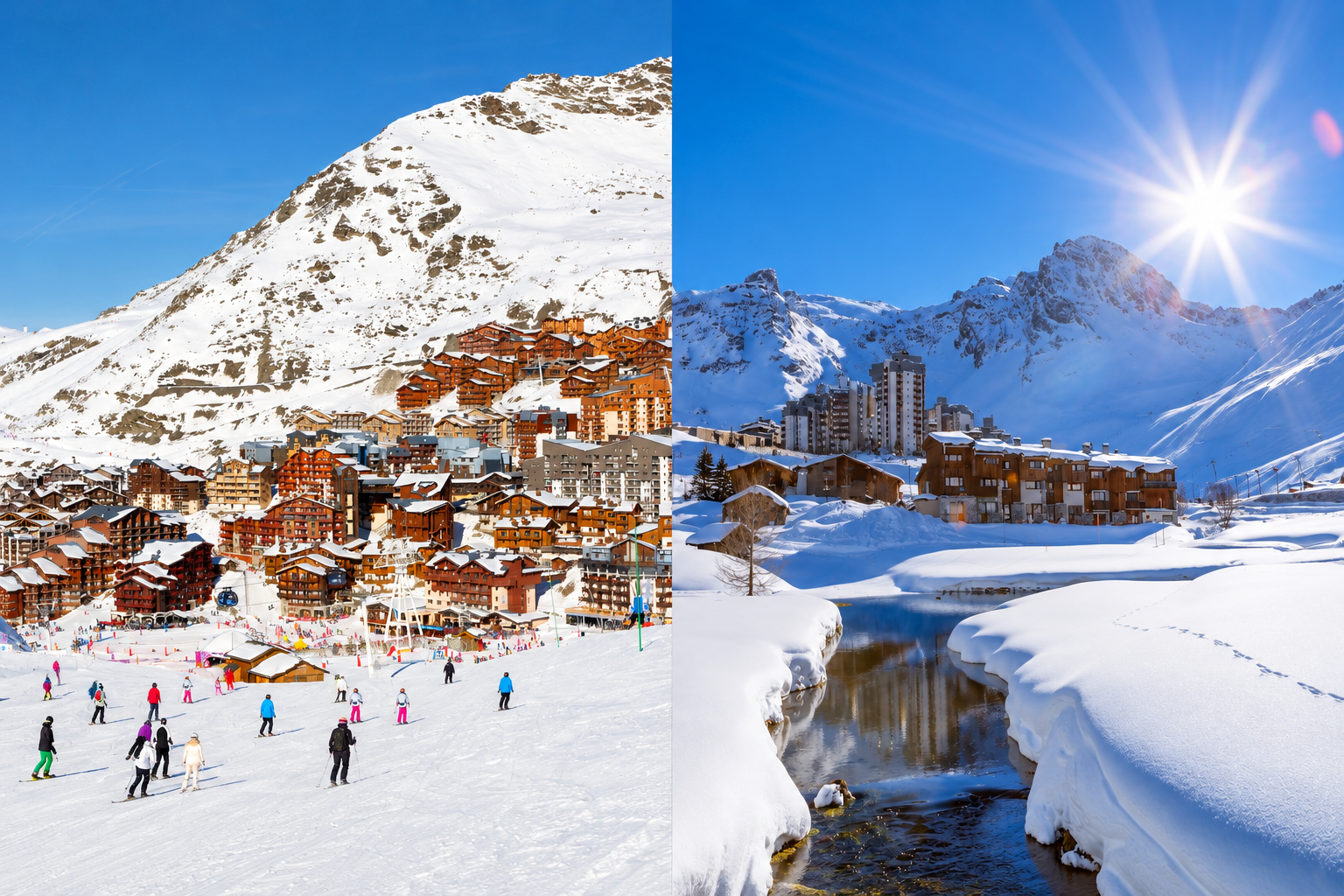
You can ski high, stay close to the slopes and enjoy lively après-ski in both Val Thorens and Tignes. Both offer extensive linked skiing, good learning areas and plenty to do when you fancy an afternoon off.
Val Thorens gives you access to the larger Three Valleys network from a compact resort at 2,300m. In Tignes, you can explore the shared Tignes–Val d’Isère area, ski the Grande Motte glacier and choose between several villages with different atmospheres.
Choose Val Thorens for exploring the biggest linked ski area and keeping your accommodation, skiing and nightlife close together. Choose Tignes for challenging terrain, glacier skiing and a wider choice of village settings.
Val Thorens vs Tignes at a glance
| Key factor | Val Thorens | Tignes |
|---|---|---|
| Best for | Exploring the Three Valleys, convenient slope access and nightlife | Challenging skiing, glacier terrain and a choice of villages |
| Full linked ski area | 600km across the Three Valleys | 300km with Val d’Isère |
| Main resort altitude | Around 2,300m | Around 2,100m in Le Lac and Val Claret; lower villages at 1,550–1,800m |
| Highest skiing | 3,230m in the linked area | 3,456m |
| Beginners | Free carpets and EasyRider progression | Free learning lifts in several villages |
| Intermediates | Particularly good for long days exploring different valleys | Excellent blues and reds across contrasting sectors |
| Advanced skiers | Goitschel, Combe de Caron and wider Three Valleys terrain | La Sache, Naturide pistes and extensive guided freeriding |
| Snow reliability | Higher resort base and extensive high-altitude skiing | Higher upper slopes and the Grande Motte glacier |
| Families | Compact layout and convenient accommodation | Good learning facilities and free passes for under-eights |
| Après-ski | Lively venues within one resort | Strong scenes in Val Claret and Le Lac |
| Non-skiers | Le Board, mountain activities, cinema and bowling | Le Lagon, Tignespace and organised mountain activities |
| Access from Geneva | Around 3–3.5 hours | Around 3 hours |
The quick verdict
Choose Val Thorens if: You want to explore different valleys, stay near the slopes and walk between your accommodation, restaurants and bars.
Choose Tignes if: You enjoy demanding skiing, want access to glacier slopes and would like to choose between a lively high-altitude base and a quieter village.
How do the ski areas compare?
Choose Val Thorens if you want the largest linked network. Its local Val Thorens–Orelle area has 150km of pistes, while a Three Valleys pass opens up 600km across Les Menuires, Saint-Martin-de-Belleville, Méribel and Courchevel.
You’ll need to plan your return when exploring farther afield. Val Thorens sits towards one end of the network, so a day in Courchevel involves several connecting lifts and pistes.
Tignes shares 300km with Val d’Isère. You can ski between the resorts via the Tovière or Fresse connections, combining Grande Motte’s high slopes with Bellevarde, Solaise and Le Fornet. There’s more than enough for a week, even though the headline total is smaller.
Winner: Val Thorens for linked ski-area size.
Number of pistes by difficulty
| Piste grade | Three Valleys, accessed from Val Thorens | Tignes–Val d’Isère |
|---|---|---|
| Green | 50 | 23 |
| Blue | 137 | 67 |
| Red | 113 | 41 |
| Black | 37 | 29 |
| Total | 337 | 160 |
Percentage of pistes by difficulty
| Piste grade | Three Valleys, accessed from Val Thorens | Tignes–Val d’Isère |
|---|---|---|
| Green | 14.8% | 14.4% |
| Blue | 40.7% | 41.9% |
| Red | 33.5% | 25.6% |
| Black | 11.0% | 18.1% |
These tables use the resorts’ published piste counts, with percentages calculated from the number of runs rather than kilometres. They cover the full linked areas, not just the slopes beside each resort. Published totals can change as pistes are added or reclassified.
Which is better for beginners?
Both give you free places to start, so check the walk from your accommodation to your lesson meeting point before choosing.
In Val Thorens, you can practise beside the Musaraigne, Campagnols and Castor and Pollux carpets. Once you’re ready, the EasyRider pass costs half the standard public rate and covers selected lifts, including the 2 Lacs gondola and Cascades chairlift. These give you access to green and blue progression routes without paying for the entire area. Our Val Thorens beginner’s guide explains the options.
In Tignes, you can start around Rosset and Almes in Le Lac or Bollin in Val Claret, with free learning lifts in both villages. As you improve, Grattalu offers a wider blue piste for practising longer turns. Stay near the area where you’ll take lessons; choosing a different village can add an unnecessary bus journey. See our beginner’s guide to Tignes.
Winner: Draw
Which is better for intermediates?
Choose Val Thorens if you enjoy setting off with a different destination each morning. You can stay local on red Christine beneath Péclet, head over to Orelle for red Mauriennaise, or explore Les Menuires and Méribel with the full-area pass.
Christine offers around 700m of descent, while Mauriennaise combines rolling sections with a steeper final pitch. You have plenty of worthwhile skiing before making the longer journey towards Courchevel.
Tignes is excellent for intermediates too. Warm up on Grattalu’s blue slopes, explore towards the Aiguille Percée, then tackle Double M when you’re comfortable on sustained reds. You can also cross into Val d’Isère for another substantial selection of pistes. The glacier-to-Val Claret descent gives you a long run back towards your accommodation rather than a succession of short laps.
Winner: Val Thorens for the variety of a full week exploring.
Which is better for advanced skiers?
We’d choose Tignes if steep terrain and freeriding are the main reasons for your trip.
La Sache gives you a demanding black descent towards Les Brévières, with sections that aren’t systematically groomed. You can also try the marked, ungroomed Naturide pistes before booking a guide to explore beyond the piste network. Across in Val d’Isère, the Face de Bellevarde adds another substantial challenge.
Val Thorens has challenging skiing of its own. Try Goitschel for a steep, sustained black piste, or head towards Combe de Caron. With the full Three Valleys pass, you can also plan days around demanding terrain elsewhere in the network.
For off-piste skiing in either resort, book a qualified local guide and carry the appropriate avalanche equipment. Lift access doesn’t indicate whether a route is safe.
Winner: Tignes
Which is better for freestyle?
You can build a good park week around either resort.
In Val Thorens, VT Park occupies around 70,000m² in the Plateaux sector, with jumps, rails and boxes of different sizes. You can progress through the features without everyone in your group needing the same ability.
In Tignes, head towards Grattalu for the easier snowpark lines, with more demanding features accessed from the Col du Palet lift. The nearby boardercross adds another option if you prefer banked turns and rollers to rails and jumps.
Winner: Draw
Which is more snow-sure?
Val Thorens has the advantage if you want snow around your accommodation. Its village sits at 2,300m, around 200m above Tignes Le Lac and Val Claret, and much higher than Tignes’ lower villages. The Val Thorens–Orelle area has 90% of its terrain above 2,000m.
Tignes reaches higher, with skiing up to 3,456m on Grande Motte. Its glacier terrain and high main villages make it a strong choice for early- and late-season holidays too. You shouldn’t rule it out simply because Val Thorens has the higher village.
For late April, check the linked-area closing dates. In 2026/27, Val Thorens–Orelle plans to stay open until 2 May, but the wider Three Valleys season ends on 18 April. Tignes also plans skiing until 2 May, with opening arrangements varying towards the end of the season.
Winner: Val Thorens
Which is better for families?
For families with children aged five to seven, we’d look closely at Tignes. Its free lift passes for under-eights can make a substantial difference, compared with free passes for under-fives in Val Thorens.
Stay in Le Lac if you want learning slopes, shops and Le Lagon swimming pool close together. The pool has a three-lane slide, a fun pool and a paddling pool, giving you an easy afternoon away from skiing.
Val Thorens is equally practical when you choose accommodation near the lesson meeting points. Its compact layout helps with equipment, lunch breaks and meeting up, while Le Board has swimming and children’s water-play facilities.
Check its Family Flex offer before comparing prices: eligible families can buy passes at the child rate, which may be particularly useful with older children.
Winner: Tignes
Which is easier to get around?
Choose Val Thorens if you want to keep everything within one resort. You can usually walk between accommodation, shops, restaurants and bars, although the streets are hilly and your precise location still matters.
In Tignes, choose your village first. Val Claret puts you near the Grande Motte access, restaurants and lively après. Le Lac gives you a central base with learning slopes and sports facilities, while Le Lavachet offers a quieter alternative nearby.
Tignes 1800 and Les Brévières provide different settings again, with more village character in Les Brévières. Free buses connect the villages, but check the relevant timetable if you plan to eat or drink somewhere other than your own base.
Winner: Val Thorens
Which has better après-ski and nightlife?
Choose Val Thorens if your group wants to meet for après and carry on into the evening without travelling between villages. La Folie Douce and Bar 360 provide mountain parties, while Saloon offers live music and DJs back in resort. Our Val Thorens après-ski guide covers more options.
You can have just as lively an afternoon in Tignes. Try Cocorico at the foot of the slopes in Val Claret or Loop Bar in Le Lac for live music and a terrace session. The main difference is that the nightlife is split between villages, so stay near the venues you expect to use most. See our Tignes après-ski and nightlife guide.
Winner: Val Thorens
Which has better restaurants?
You can eat well in both, from casual meals to special-occasion dining.
In Val Thorens, book Les Explorateurs at Hotel Pashmina for a special dinner, or try La Maison for brasserie dishes and Savoyard cooking. The compact centre makes it straightforward to try different places during the week.
In Tignes, Ursus in Val Claret offers a distinctive, forest-inspired setting for a special meal. For something more casual, Tummy serves pizzas, burgers and pasta nearby. You’ll have the easiest choice of evening restaurants if you stay in Val Claret or Le Lac.
We also love… Le Panoramic in Tignes for lunch at 3,032m, reached by the Grande Motte funicular. In Val Thorens, Chalet de la Marine is an option for a longer mountain lunch find more suggestions in our Val Thorens mountain restaurant guide.
Winner: Draw
Which is better for non-skiers?
Both suit someone who wants organised activities and sports facilities during the week.
In Val Thorens, you can swim, use the wellness area or book indoor sports at Le Board, then add cinema, bowling or a guided snowshoe outing. Its compact layout also helps you meet the skiers in your group for lunch or après. Our Val Thorens non-skiing guide covers the alternatives.
In Tignes, combine Le Lagon with activities at Tignespace, or book a mountain excursion. Stay in Le Lac if you want the main sports facilities nearby. You have a choice of village settings, but travelling between them takes more planning than walking around Val Thorens.
Winner: Draw
Which offers better value?
Val Thorens currently has the cheaper main-season adult lift passes. For 2026/27, six days cost €367.50 for Val Thorens–Orelle or €421 for the Three Valleys. A Tignes–Val d’Isère pass costs €468 for six days, with a seventh day included.
That doesn’t automatically make the whole holiday cheaper. Tignes’ free passes for under-eights can change the result for families, while accommodation location, board basis and included extras can outweigh the adult pass difference.
Both have self-catering apartments, hotels and catered options. Compare Val Thorens deals with Tignes deals for the same dates, checking whether your lift pass covers the area you intend to ski.
Winner: Val Thorens
Which is easier to reach?
From Geneva, there’s little reason to choose between them on transfer time alone. Allow around 3–3.5 hours for Val Thorens and approximately 3 hours for Tignes, with traffic, snow and shared-coach stops potentially adding time.
If you’re flying into Grenoble, Val Thorens has the advantage: Iglu’s approximate transfer times are 3 hours 15 minutes, compared with around 4 hours for Tignes. Compare the flight times and actual transfer arrangements included in your holiday.
Winner: Draw from Geneva; Val Thorens from Grenoble
The verdict: Val Thorens or Tignes?
- Best for the largest linked ski area: Val Thorens
- Best for beginners: Draw — choose accommodation near your lessons
- Best for intermediate exploration: Val Thorens
- Best for challenging terrain and freeriding: Tignes
- Best for freestyle: Draw
- Best for snow around your accommodation: Val Thorens
- Best for families with children aged five to seven: Tignes
- Easiest resort to get around: Val Thorens
- Best for convenient après-ski and nightlife: Val Thorens
- Best for restaurants: Draw
- Best for active non-skiers: Draw
- Best for adult lift-pass prices: Val Thorens
- Easiest to reach: Draw from Geneva; Val Thorens from Grenoble
If your group enjoys exploring all day and meeting up for a lively evening, we’d book Val Thorens. If you’re keen on challenging descents and guided off-piste days, we’d choose Tignes — then pick the village that suits the rest of your holiday.
Still not sure? Talk to an Iglu Ski Specialist about your group’s ability, budget and travel dates.