


 Favourites
 Customer portal


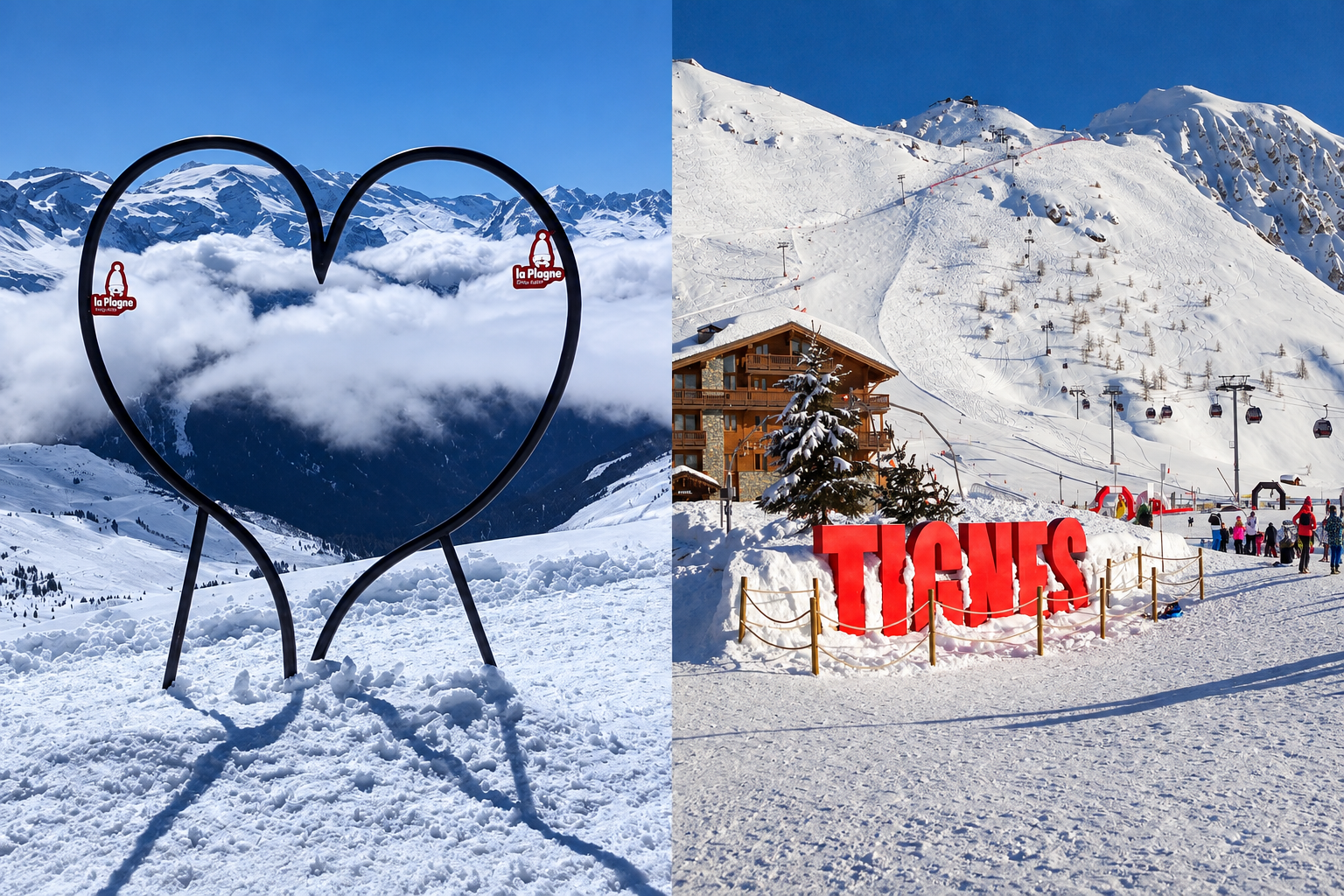
With extensive skiing, a choice of villages and plenty to keep everyone from families with young children to large groups entertained, La Plagne and Tignes are both excellent ski resorts.
Our data bears that out. Both are among the ten most searched resorts on Iglu Ski, with Tignes receiving about two and a half times as many searches as La Plagne.
Popularity aside, each has qualities that lend themselves to different types of skiers – but which is right for you? La Plagne is particularly good for exploring on blues, with open bowls, wooded runs and a wide choice of villages, while Tignes has higher skiing, more demanding terrain nearby and superior après-ski.
In this article, we compare the resorts on key factors to help you decide where to go for your next ski holiday.
La Plagne vs Tignes at a glance
| Key factor | La Plagne | Tignes |
|---|---|---|
| Best for | Beginners, varied cruising and families | Challenging skiing, snow reliability and après |
| Full linked ski area | 425km across Paradiski | 300km with Val d’Isère |
| Resort altitude | 1,250–2,100m, depending on village | 1,550–2,100m, depending on village |
| Highest lift locally | 3,080m | 3,456m |
| Beginners | Village learning areas and extensive blue-run progression | Free learning lifts and good local progression |
| Intermediates | Open bowls, wooded pistes and varied sectors | High-altitude cruising and demanding reds |
| Advanced skiers | Rochu, Bellecôte and substantial off-piste options | La Sache, ungroomed blacks and access to Val d’Isère |
| Snow reliability | Very good, particularly in the higher villages | Excellent, with a longer planned season |
| Families | Particularly good for children learning to ski | Strong facilities and more challenge for experienced family members |
| Villages and getting around | More choice of village styles; some bases are far apart | Convenient upper villages linked by free buses |
| Après-ski | Lively venues across several villages | Stronger nightlife in Val Claret and Le Lac |
| Restaurants | Good village and mountain dining | Stronger choice for special occasions |
| Non-skiers | Mountain excursions, spas and village walks | Particularly good indoor sports and leisure facilities |
| Relative cost | ££ | £££ |
| Access from Geneva | Around 2½–3 hours by road | Around 3–3½ hours by road |
Ski-area figures depend on your pass: La Plagne has 225km locally, with a separate upgrade for the full Paradiski area. Tignes’ main multiday pass covers the shared Tignes–Val d’Isère area.
The quick verdict
Choose La Plagne if: You want plenty of beginner-friendly skiing, different sectors to explore and a choice between high-altitude accommodation and more traditional villages.
Choose Tignes if: You want access to more challenging skiing, slightly more snow reliability and lively bars close to the main resort bases.
How do the ski areas compare?
La Plagne wins on size. Its 225km of local pistes becomes 425km when you add Les Arcs and Peisey-Vallandry, linked by the Vanoise Express cable car. You can spend a full week exploring La Plagne alone, but the Paradiski upgrade is worth considering if you want to explore Les Arcs and Peisey-Vallandry too. If you do plan on venturing into Les Arcs, stay in Montchavin-Les Coches for the quickest access, or Plagne Bellecôte or Belle Plagne if you want to stay higher up.
Tignes and Val d’Isère share 300km of pistes, with routes between the resorts via Tovière and Fresse. While a smaller area overall, it offers ample skiing for a week, including open cruising, steep pistes and glacier terrain. La Plagne’s bigger map will appeal to you most if you like racking up the miles on gentler pistes, whereas Tignes’ terrain is more compelling if you like a challenge or more technical skiing.
Winner: La Plagne for the size of the linked ski area
Which is better for beginners?
La Plagne wins for progression beyond the nursery slopes. Start at the Boulevard learning area in Plagne Centre or the magic-carpet area in Belle Plagne, then follow the marked CoolSki routes. The extensive network of blues gives improving beginners plenty to explore without repeatedly stepping up to reds. Our La Plagne beginner’s guide explains the different village options.
Tignes is excellent for novice skiers too. Its nine free beginner lifts include the Claret carpet and Bollin chairlift in Val Claret, and the Centre carpet, Rosset and Almes chairs in Le Lac. When you're ready, the blues around Palafour or Prariond above Val Claret are perfect stepping stones. Tignes offers good progression, but La Plagne has more scope for a whole group to explore comfortably on easier pistes. See our Tignes beginner’s guide.
Winner: La Plagne
Which is better for intermediates?
La Plagne has the edge for varied cruising. You can explore open slopes, wooded runs and different parts of the mountain while sticking mainly to blues and manageable reds. The long Bozelet blue on the Champagny side combines open slopes with views of the Vanoise mountains, while Montchavin–Les Coches and Montalbert provide wooded alternatives. For a higher red, try Lanche Ronde, accessible from the intermediate station of the Glaciers gondola.
Tignes is especially good for confident intermediates who enjoy longer, more sustained descents. Anémone below Palafour is a fun blue, while Double M is a more demanding red that takes you down to Val Claret. La Plagne offers more variety for confident skiers who like to explore, though Tignes is the better choice if you like to tackle tougher pistes.
Winner: La Plagne
Which is better for advanced skiers?
With lots of challenging skiing close to the main villages, Tignes is our winner for advanced skiers. La Sache, descending towards Les Brévières, is demanding and isn’t systematically groomed. The resort’s Naturide black runs provide further marked, ungroomed terrain, while you can cross into Val d’Isère for legendary descents such as the Face de Bellevarde. There’s enough variety to keep strong skiers busy throughout the week.
In La Plagne, Rochu and Bellecôte provide challenging blacks in the high sector, and the ungroomed Natur’ runs are fantastic for freeriders. Its off-piste terrain, including the north face of Bellecôte, can be a major attraction for experienced skiers with a qualified guide.
Winner: Tignes
Which is more snow-sure?
Tignes has the stronger case, particularly outside the main winter months. Le Lac and Val Claret sit at around 2,100m, and the Grande Motte cable car reaches 3,456m. For 2026/27, Tignes plans to open progressively from 21 November, with the shared area scheduled from 28 November to 2 May, subject to conditions.
La Plagne is dependable too: more than 70% of its local ski area sits above 2,000m, and different slope aspects help preserve skiing as conditions change. Its higher villages are good choices for a snowy base, while wooded sectors are useful in poor visibility. The planned main season runs from 12 December to 24 April. That said, Tignes’ extra altitude and longer season give it the advantage for November and late-April trips.
Our Tignes vs Val d’Isère comparison looks more closely at the shared area’s snow reliability and terrain.
Winner: Tignes
Which is better for families?
La Plagne narrowly wins if you have children who are learning and want to ski together after lessons. Belle Plagne is a good base: it’s car-free, has a local learning area and plenty of accommodation close to the pistes. Once your kids are comfortable on blues, the Funslope above Plagne Bellecôte, reached by the Arpette chairlift, has tunnels, banked turns and small bumps, which are fun challenges that can aid their progression.
Tignes might suit you better if your kids already have some ski trips under their belts. Le Lac has learning slopes and Le Lagon’s swimming pools and slides, while experienced adults have challenging terrain nearby. It also has a financial advantage for younger children: lift passes are free for under-eights, compared with under-fives in La Plagne. For children aged five to seven, compare the complete holiday cost before deciding. Both appear in our best family ski resorts in France guide.
Winner: Draw
Where should you stay, and how easy is it to get around?
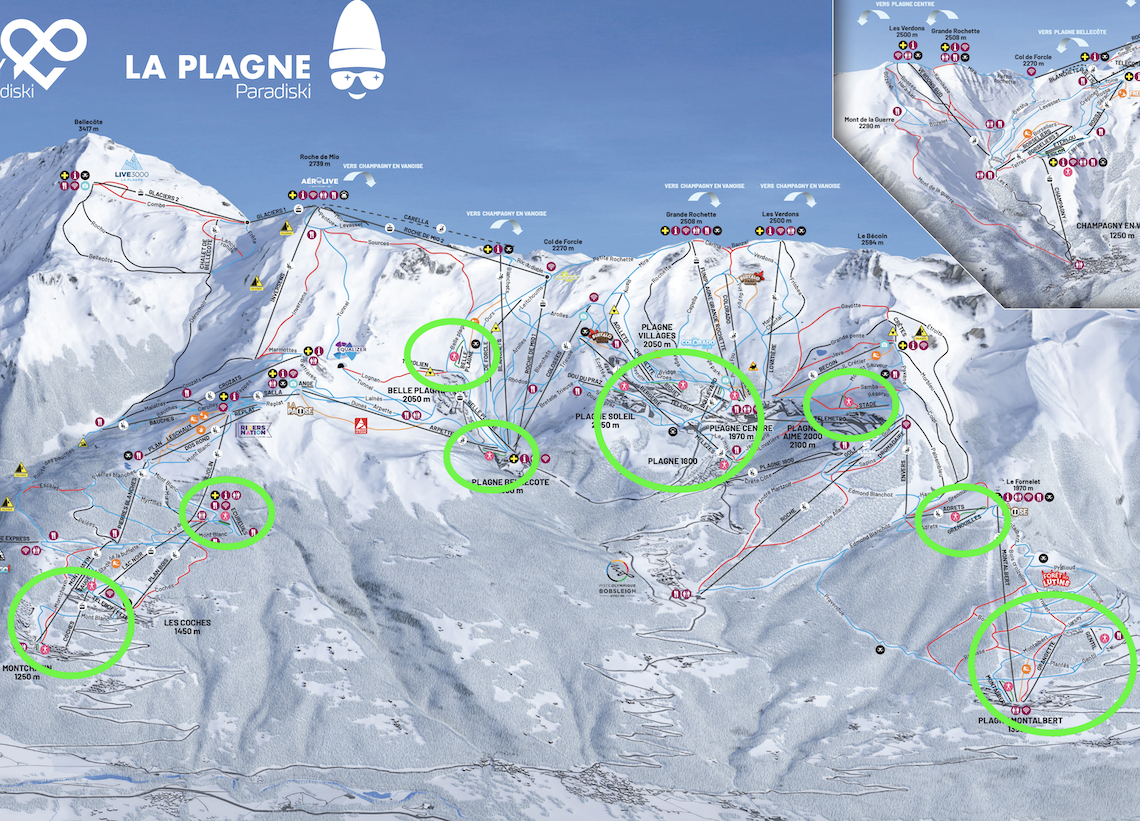
La Plagne offers more choice of setting:
- Plagne Centre and Plagne Bellecôte: Practical bases for lifts, shops and exploring different sectors.
- Belle Plagne: A car-free village at 2,050m, with restaurants and accommodation close to the slopes.
- Plagne 1800: A popular option for chalets and a quieter evening.
- Montalbert, Montchavin–Les Coches and Champagny: More traditional surroundings, with longer journeys to some of the high terrain.
Free buses connect the main altitude villages, alongside links such as the Belle Plagne gondola, Télébus and Télémétro. The lower villages are separate bases, so don’t assume you can easily visit every part of La Plagne after skiing.
Tignes is easier to organise around its two main upper bases. Le Lac should be your first choice for amenities and sports facilities, while Val Claret has quick access to Grande Motte and lively evenings. Free shuttles connect them with the other villages. Tignes 1800 and Les Brévières are quieter, but check the journey to the lifts, activities and evening venues you expect to use.
Winner: Tignes for getting between the main upper villages; La Plagne for choice of village atmosphere
Which has better après-ski?
Tignes wins if nights out are a priority. Cocorico in Val Claret has an outdoor stage with live music and DJs, while Loop Bar in Le Lac is a convenient stop after skiing. Stay in one of those villages to keep the evening journey short. Our Tignes après and nightlife guide has more suggestions.
Though not a classic après-ski resort, La Plagne still has some lively venues. La Bergerie has music on its mountain terrace from 2.30pm, Le Bonnet hosts DJs and entertainment in Plagne Bellecôte, and La Mine in Plagne 1800 is a good pub option. The difference is the choice across an evening: Tignes offers more for groups wanting afternoon après followed by a late night. See our La Plagne après guide for more places to go.
Winner: Tignes
Which has better restaurants?
Tignes has the edge for special occasions. Ursus in Val Claret is the standout dinner choice, while La Pignatta is a good choice for an everyday meal, serving pizzas and Italian–Savoyard dishes. We also love Le Panoramic for a mountain lunch above Val Claret, reached by the Perce-Neige funicular.
La Plagne has good alternatives, though location matters more because its restaurants are spread across the villages. Union in Montalbert is a top-tier option if you’re staying on that side. Le Chalet des Colosses in Plagne Bellecôte serves traditional and Savoyard dishes, while Le Chalet de la Roche, beside the chairlift, is worth a lunch stop for homemade pasta and pizza.
Winner: Tignes for special-occasion dining
Which is better for non-skiers?
We love that Tignes has so many activities within easy reach, particularly in Le Lac. Le Lagon offers swimming and wellness facilities, while nearby Tignespace has climbing, squash, badminton and other indoor sports. There’s also a cinema in Val Claret. Someone taking several days off skiing can make plans without relying entirely on the weather.
La Plagne has a pleasant mix of village walks and mountain outings. You can buy a pedestrian ticket to Live 3000, visit the spa in Belle Plagne or try a visitor experience on the Olympic bobsleigh track. These are worthwhile attractions, but they’re spread out, so choose your base around them. Our La Plagne activities guide has more ideas.
Winner: Tignes for convenient indoor activities
Which offers better value?
Based on Iglu Ski booking data for the same month over the last couple of seasons, La Plagne is around 15% cheaper on average when comparing similar property ratings and board bases. For catered three-star holidays, the difference rises to 30%.
Lift passes also affect the calculation. Iglu’s 2026/27 guide lists a six-day Paradiski pass at €412, while the main-season Tignes–Val d’Isère pass is €468, including a seventh day. La Plagne’s local pass is another option if you won’t visit Les Arcs. Tignes’ free under-eight passes can reduce the difference for families.
Winner: La Plagne for most skiers
Which is easier to reach?
La Plagne usually has the shorter transfer. From Geneva, allow roughly 2.5–3 hours by road, compared with around 3–3.5 hours to Tignes. Shared coaches, Saturday traffic and snowfall can extend either journey. Chambéry is another option, with transfers of around 2 hours to La Plagne and 2 hours 15 minutes to Tignes.
By rail, Aime-la-Plagne serves the main La Plagne altitude villages, while Bourg-Saint-Maurice is the usual station for Tignes, followed by a bus or road transfer.
Winner: La Plagne
The verdict: La Plagne or Tignes?
- Largest linked ski area: La Plagne
- Beginners: La Plagne
- Varied intermediate cruising: La Plagne
- Advanced skiing: Tignes
- Snow reliability and a longer season: Tignes
- Families: Draw
- Getting between the main upper villages: Tignes
- Choice of village atmosphere: La Plagne
- Après-ski: Tignes
- Special-occasion restaurants: Tignes
- Convenient indoor activities for non-skiers: Tignes
- Value: La Plagne for most skiers
- Access: La Plagne
For a first trip or a group happiest exploring blues, we’d lean towards La Plagne. If your group includes keen skiers who want demanding descents, a longer season and lively evenings, Tignes is likely to be the better fit.
Still deciding? Speak to an Iglu Ski Specialist and we’ll help you choose the right village, accommodation and lift pass for your group.